
In the early days of the internet, the recipe for SEO success was simple: post often, keep it short, and mention your keyword as many times as possible. Fast forward to today, and the power of long-form content has completely shifted in the landscape. You’ve likely noticed that when you search for a complex topic, the top results aren’t 300-word snippets; they are massive, comprehensive guides.The power of long- form content why deep dives understand SEO the best
This shift toward long-form content—typically defined as articles over 1,500 to 2,000 words—isn’t just a trend. It is a strategic response to how search engines and humans interact with information.
Here is an analysis of why deeper, comprehensive guides consistently outperform short posts.
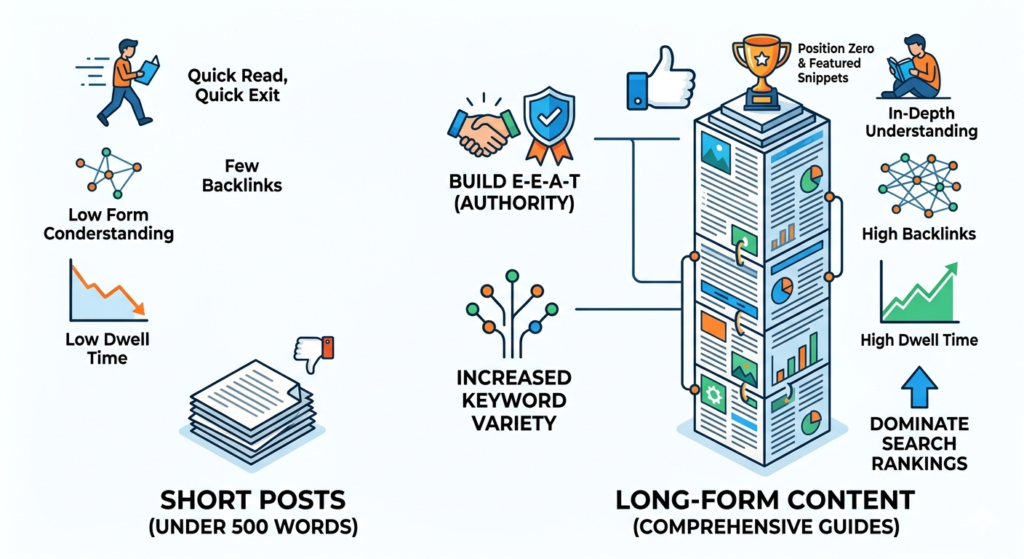
1.How the Power of Long-Form Content Establishes E-E-A-T
Google uses a framework called E-E-A-T (Experience, Expertise, Authoritativeness, and Trustworthiness) to evaluate the quality of content. It is incredibly difficult to prove you are an expert on a subject in 500 words.
When you write a 2,000-word guide that covers a topic from every angle—including history, best practices, common mistakes, and future predictions—you are signaling to both Google and your readers that you truly know your stuff. This builds the “Trust” factor, which is the most important component of the framework.
2. How the Power of Long-Form Content Increases Keyword Variety
Short posts usually target one primary keyword. Long-form content, by its very nature, covers a broader range of related subtopics.
- Long-Tail Keywords: Longer articles naturally include “long-tail” phrases (specific 3–5 word questions) that people actually type into search bars.
- LSI (Latent Semantic Indexing): Search engines look for related terms to understand context. If you’re writing about “Digital Marketing,” a long-form post will naturally mention “SEO,” “Social Media,” “ROI,” and “Analytics.” This helps search engines categorize your page more accurately.And understand why long-content works.
- 3. Increased “Dwell Time”
Dwell time is the amount of time a visitor spends on your page before clicking back to the search results.
If a user lands on a short post, they might finish it in 60 seconds and leave. If they land on a comprehensive guide that provides immense value, they might stay for five or ten minutes. High dwell time sends a strong signal to search engines that your page is helpful and relevant, which can lead to higher rankings over time.
4. It Is a “Backlink Magnet”
In the SEO world, backlinks (other websites linking to yours) are like votes of confidence. People rarely link to short, surface-level blog posts because they don’t provide enough unique value to reference.
However, a “Ultimate Guide” or a “Complete Resource” is highly linkable. Other bloggers and researchers prefer to link to a single source that explains everything rather than five different short articles. One high-quality long-form piece can generate more backlinks than ten short pieces combined.
How to Structure Long-Form Content Without Boring the Reader
The biggest risk with long-form content is creating a “wall of text” that scares readers away. To keep your audience engaged, use these formatting strategies:
- Clear Headings (H2s and H3s): Break the article into logical sections so readers can skim and find exactly what they need.
- Bullet Points and Numbered Lists: These make complex information much easier to digest.
- Visual Breaks: Use images, infographics, or charts every few hundred words to give the reader’s eyes a rest.
- Internal Navigation: For very long guides, include a “Table of Contents” with clickable links at the beginning.
Quality Over Quantity: The “Thin Content” Warning
It is important to remember that length does not equal quality. Adding “fluff” or repetitive sentences just to hit a word count will actually hurt your SEO. Google is smart enough to recognize “thin content” that doesn’t provide real value.
The goal isn’t just to write more; it’s to write better. A comprehensive guide should answer every question a user might have about that specific topic, leaving them with no reason to click back to Google to find another source.
Conclusion
While short posts still have their place—such as for quick news updates or simple “how-to” tips—long-form content is the engine that drives sustainable organic growth. By investing the time to create deep, comprehensive guides, you aren’t just writing a blog post; you are building a long-term digital asset that earns trust, attracts links, and dominates the search results.
Ready to start? Pick a topic you are passionate about and try to write the most thorough guide currently available on the internet for it!